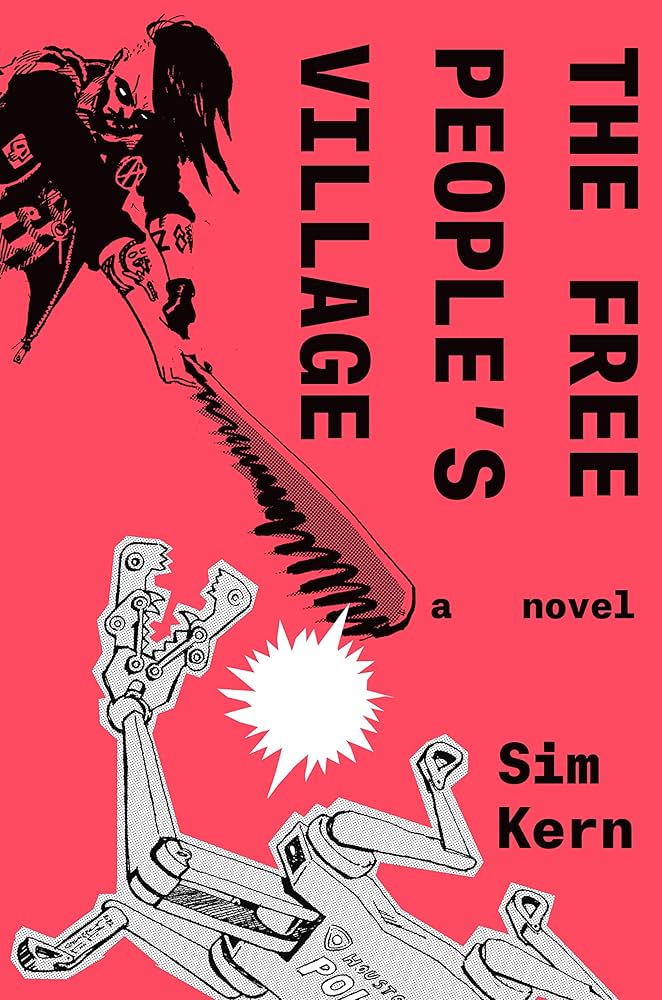
The Free People's Village
Sim Kern
Alternate timeline novel set in the year 2020. Following Al Gore's victory in the 2000 US presidential election, the United States governement declares a war on climate change. At face-value, the war on climate change is designed to make the world greener through fiscal policies, most notably a "carbon tax" which increases the price of goods and services that use excessive electricity or produce unnecessary pollution. Maddie is an early twenties school teacher at a predominately black high school in Houston, Texas. When she's not teaching, Maddie is either practicing or performing with her queer punk band, "Bunny Bloodlust." The band lives and performs at a complex called, "The Lab," which is owned by Maddie's boyfriend and Bunny Bloodlust Bassist, Fish. Tensions arise as drummer Gestas and guitarist Red fight Fish over the direction of the band and the impact gentrification has on the local community. Maddie supports Gestas and Red's side (and also secretly loves Red) but is worried that standing up to Fish would mean eviction and the Lab being shut down for good. After eminent domain over the Lab is enforced by the US government in order to build a hyper rail, the community bands together to protest the seizure of land by forming, "The Free People's Village." Will Maddie stand-up to Fish? Will the Free People's Village push back against the government? Did Obama win in this timeline? Some of these questions may or may not be answered!
I was discussing the topic of this book with a liberal friend of mine while on a long car ride. I explained the premise of the book and how its an alternate universe where Al Gore beat George Bush, and my friend immediately jumped to the conclusion that this timeline must be better. I then explained the premise of the book was that everything was in fact not better, arguably worse in some cases, and the liberal sitting next to me defensively jumped to the conclusion that this book was written by a conservative in disguise secretly paid off by big oil. This interaction shaped how I viewed the book. From a leftist perspective, the book dissects the nature of systemic issues by pointing out that an underlying capitalist superstructure driven by expansion and profit will inevitably corrupt any well-meaning political goal. Furthermore, decisions enforced by the oligarchy from the top-down will not serve the interests of the people, and thus solving the environmental crisis will require bottom-up, grassroots decision-making. From a liberal perspective, the goal is to solve the environmental crisis as soon as possible and by any means necessary because the end will justify the means. Therefore, even if a carbon tax bankrupts the working class or the construction of public transit displaces impoverished communities, within the coming decades the city will have environmentally-efficient transportation and carbon emissions should decrease to save the environment. I forget sometimes that I have been entrenched in leftist political dogma for a number of years, so when I initially read "The Free People's Village," The message felt too on-the-nose and I was turned off by how direct the writing felt. A more liberally-minded person could probably learn a lot from Sim's message, and ultimately the book was enjoyable enough for me to finish it within a couple days.
This was a really fascinating read because it delves into the psychology of being a leftist as well as the sociology behind coexisting in leftist spaces. That being said, my primary criticism is that the book often times comes across as preachy. The main character, Maddie, starts off as a progressive liberal with an abandoned faith in her dogmatic adherence to Christianity. Maddie shifts from a liberal to a leftist ideology over the span of a year where every day contained at least an allocated hour of time dedicated to lectures from her bandmate Gestas or a random person of color that she could learn from. This is what makes Maddie's psychology fascinating to me, because she narrates the book like she is guilty for the crime of existing. Her life is exhausting: It seems like she becomes a leftist not to support the general welfare of her community but rather to right some perceived sin of existence. I have recommended the book to two other people, and after reading a chapter they dropped the book simply because they could not tolerate the narrator's anxious perception of the world around them. I could see how that's not for everyone, but I genuinely do like it. This book might have annoying characters, but they are all real people I have encountered during protests and volunteering. If you want to see an authentic representation of an anarchist community, then this book expresses the true nature of contemporary anarchism.
It was exciting to read a novel set in my home-city of Houston. There aren't too many stories set in the fourth most populous city in the US, and I would guess it's because the city is isolated by its archaic car-centric design which encourages the population (with the means to do so) to move out into the surrounding suburbs and invest little to no money into the city's infrastructure outside of the massive highway system. A quick google search for, "Houston infrastructure," will reveal that everyone who lives in Houston agrees that this gas-guzzling, oil-dripping, smog-filled concrete hell was designed by an oligarchy of corrupt, carpetbagging capitalist cronies. To quote Hunter S. Thompson: "Houston is a cruel, crazy town on a filthy river in East Texas with no zoning laws and a culture of sex, money, and violence." What I love about "The Free People's Village," is that it does not hold back from showing the two-faces of Houston: Suburban Houston and "real" Houston. Affluent characters all come from the suburbs and the downtrodden exist in the inner city as expendable at the whims of the powerful.